TL;DR
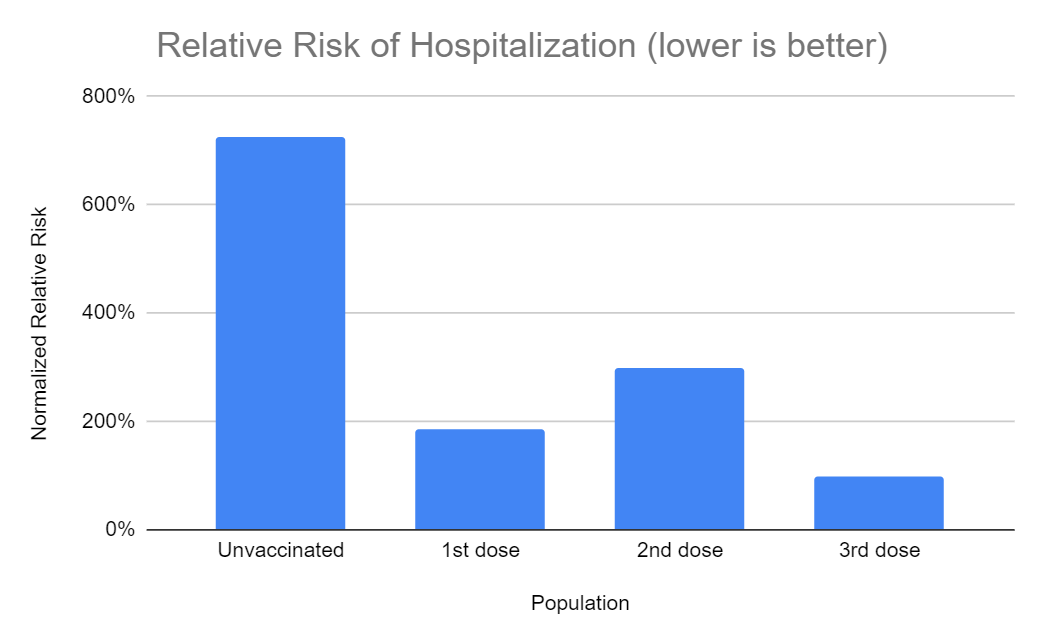
According to recent data from Scotland, unvaccinated people are 7.2 times MORE likely to be hospitalized because of covid than people with all 3 shots.
Why I looked at this.
This morning, I ran into this article, in which an excellent writer with a lot of passion argues against vaccinations. She also cites her sources, which I really appreciate, so we can look at the same data.
Unfortunately her math skills are not up to her writing, as she failed to grasp the meaning of her sources.
Perhaps she missed this part

I’m not going to go through every claim and every source, but her first one yields an interesting (if unsurprising to my regular readers) result.
The Claim
Here’s the first claim:
"The data is now overwhelming. In Scotland, in England, in Iceland, in Canada. Double-vaccinated are the MOST likely to be infected. Un-vaccinated are the LEAST likely to be infected."
Her cited source for Scotland: https://publichealthscotland.scot/media/11223/22-01-19-covid19-winter_publication_report.pdf
Unfortunately, her cited source did NOT contain the graph she showed about case rates per 100,000k, so I’m just going on the document itself.
The Data
What her source says:

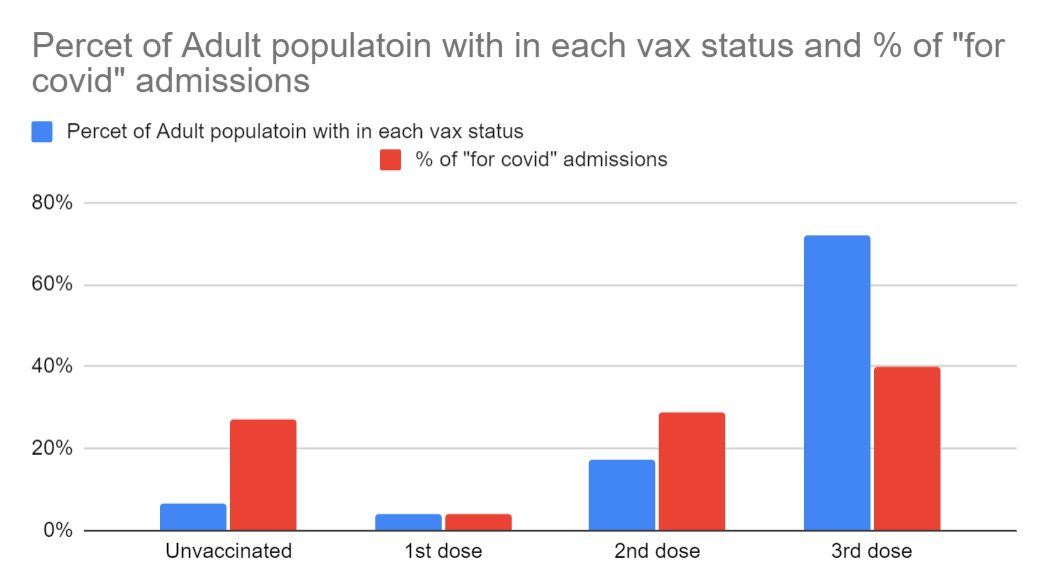
Of people admitted recently because of covid, 40% have had 3 doses, 29% 2 doses, 4% 1 dose, and 27% were unvaccinated.
This kinda looks like what she said, but let’s reiterate:
What’s Missing
What she left out:
In Scotland, according to her source, 92% of people have received at least one dose, 85% have received at least 2 doses, and 67% of people have received all 3.
So, her claim is sort of correct in the raw numbers, but incredibly wrong in the conclusion.
It probably would have made more sense just graphing the vaccination and hospitalization percentages, where red taller than blue is bad.
But it really becomes clear when you look at the relative risk of the populations (i.e. divide the hospitalization percentage by the vaccination percentage.)
The Analysis
For the calculations below I’m going to look at the adult population only in the rest of this, because chlidren are rarely hospitalized from covid (not that they can’t be, just…so far, it’s rare). I’m estimating the adult population by taking the population and subtracting out an estimate of the children.
So, of the adult population of Scotland,
| Status | Percent |
|---|---|
| Unvaccinated | 7% |
| 1st dose only | 4% |
| 2nd dose only | 18% |
| 3 doses | 72% |
The unvaccinated 7% of the population make up 27% of the cases admitted for covid, the 18% with 2 doses make up 29% of the cases, and last the 72% of the population make up only 40% of the cases.
Adding in the adult population of Scotland at 4,545,465 and the most recent weeks hospitalization data of 1040 (from her source), this works out to an unvaccinated person having 7.2x the risk for covid hospitalization as a fully vaxxed person. There is no category at lower risk for hospitalization than fully (all 3 doses) vaccinated.
Further claims fell victim to similar problems. I’m not going to do the math in detail on those here because this will get way too long and boring.
The author is clearly an excellent writer and very passionate, but equally clearly a bad mathematician.
The Conclusion
Her conclusions are the opposite of reality, the opposite of what her source showed, and the opposite of the conclusions stated in the source that she used.
(I spot checked other claims and found similar problems, but did not work through the full math on those.)
Footnotes
You’ll note that it appears that having only 1 dose of the vax is safer than having 2 doses. This is a great example of the difference between causality and correlation.
Data like this is where reachres go: "Gee, that’s funny….I wonder why…"
Then they start going "maybe it’s because…" and "how can I test that theory…"
I’ll note that the percentag of people in Scotland who have 1 dose but not 2 is the lowest of any category. It may very well be that these are the most isolated and difficult to reach, which implies lower vaccination rates…but also lower covid exposure.
Which is it? I don’t know. There are obviously a few theories, and the people whose job it is to do this stuff are likely looking into it.
